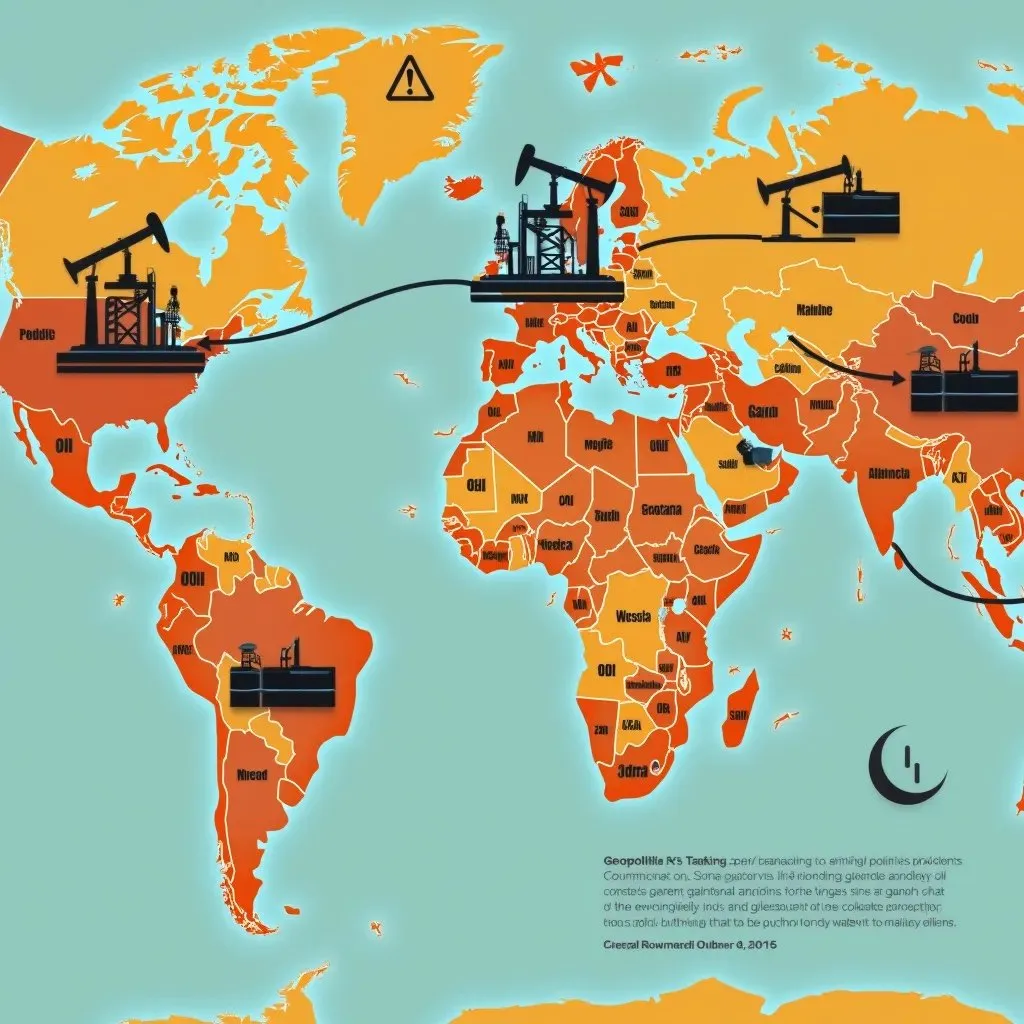
Geopolitical Risks and Their Impact on Global Oil Supply Chains
Unplanned supply disruptions cost operating companies in ways that compound quickly: crude feedstock shortages force refinery run-rate reductions, long-term offtake contracts trigger force-majeure clauses, and procurement teams scramble to re-source at spot premiums. Geopolitical events are among the least predictable triggers of these disruptions, yet the mechanisms by which they translate into supply-chain stress are well understood and, to a meaningful degree, manageable. This article examines those mechanisms and gives maintenance, operations, and procurement professionals a structured way to assess exposure and act.
Why Geopolitical Shocks Hit Harder Than Market Shocks
Research published by CEPR VoxEU makes a point that practitioners often underestimate: geopolitical oil price shocks propagate differently from demand-driven price movements. The transmission channels are broader, the uncertainty premium persists longer, and downstream industries face simultaneous cost pressure and supply uncertainty rather than one or the other. A refinery that models price risk purely on demand fundamentals will systematically underestimate its exposure when the shock originates from a conflict zone.
Three structural features amplify geopolitical shocks relative to ordinary market volatility:
-
Route concentration. A large share of seaborne crude transits a small number of straits and canals. When those corridors are threatened, there is no quick substitute — rerouting adds weeks to voyage times and absorbs tanker capacity that was allocated elsewhere.
-
Infrastructure immobility. Pipelines, terminals, and loading platforms cannot be relocated. An attack on a single export terminal can take offline production that took years to build.
-
Confidence effects. Even when physical flows are uninterrupted, the market prices in the probability of future disruption. This uncertainty premium on crude feeds directly into refinery feedstock cost before a single barrel is actually diverted.
The Strait of Hormuz: The Clearest Chokepoint Risk
No single geographic feature illustrates supply-chain concentration risk more clearly than the Strait of Hormuz. An INSS analysis describes the strait not merely as an energy export route but as the connective tissue of the entire Gulf economy. Closure or sustained harassment of traffic through Hormuz simultaneously affects crude exports, LNG shipments, and imports of food, equipment, and manufactured goods into Gulf states.
The INSS analysis asks whether a true alternative is attainable and reaches a sobering conclusion: existing bypass infrastructure — overland pipelines and Red Sea terminals — has meaningful capacity, but it cannot absorb full Hormuz volumes, and the pipelines themselves pass through territories with their own political risk profiles. For procurement teams sourcing Gulf crude, this means that the existence of bypass routes reduces but does not eliminate chokepoint exposure.
Implications for Tanker Scheduling and Freight Contracting
Reuters reported in September 2026 that oil importers are adapting to structurally longer trade routes — not as a temporary workaround but as an emerging baseline. Longer routes mean:
- Higher voyage costs absorbed either by the shipper or passed through to the buyer depending on contract terms (CIF vs. FOB).
- Larger working inventory requirements to maintain the same days-of-cover at the refinery gate, because the pipeline of in-transit crude is longer.
- Greater exposure to weather, port congestion, and secondary geopolitical events along extended routing corridors.
Procurement teams that benchmark their freight exposure only against historical short-haul routes will find their inventory models understating required stock levels under rerouting scenarios.
Supply Chain Resilience: What the Research Says
A 2026 Springer Nature study in Maritime Economics & Logistics specifically examined Middle East geopolitical disruptions and supply chain resilience. Its central finding — relevant to any operator with Gulf exposure — is that resilience is not a static property of a supply chain but a dynamic capability that must be actively maintained through redundancy, flexibility, and information quality.
The study identifies mitigation strategies that map directly onto decisions that procurement and logistics leads can make:
| Risk Dimension | Vulnerability Indicator | Mitigation Lever |
|---|---|---|
| Geographic concentration | Single-source crude slate | Multi-origin procurement contracts |
| Route dependency | All volumes through one corridor | Dual-routing clauses in freight contracts |
| Inventory buffer | Lean just-in-time stock policy | Strategic stock target reviewed against geopolitical scenario |
| Information lag | Reactive position adjustments | Early-warning monitoring integrated into procurement workflow |
| Supplier financial resilience | Counterparty exposure to conflict zones | Counterparty credit and operational risk assessment |
The table above uses qualitative indicators only; specific thresholds must be calibrated against each operator's refinery configuration, contractual obligations, and regulatory stock requirements.
A separate study published in Finance Research Letters confirms that geopolitical risks measurably impede global supply chain performance, with effects that are statistically distinguishable from general macroeconomic volatility. confirms that geopolitical risks measurably impede global supply chain performance, with effects that are statistically distinguishable from general macroeconomic volatility. The practical implication is that standard financial hedging instruments — which price commodity risk but not physical availability risk — are insufficient as a standalone response.
Illustrative Scenario: Refinery Feedstock Disruption
The following scenario is illustrative and does not represent a specific named incident.
A mid-sized coastal refinery operates on a crude slate sourced predominantly from a single Gulf exporting country, delivered by VLCC on a term contract. Geopolitical escalation in the region triggers:
- War-risk insurance surcharges that make the contracted voyage economics unfavorable for the shipowner.
- A port closure notice at the loading terminal lasting several weeks.
- Simultaneous tightening of available spot tonnage as other buyers compete for alternative routes.
The refinery's crude inventory, sized for normal voyage times, falls below minimum operating level before an alternative cargo can be sourced and delivered via a longer routing. The refinery reduces throughput. Downstream product commitments — jet fuel to an airline, diesel to an industrial customer — are not met in full. Force-majeure claims follow.
The failure mode here is not the geopolitical event itself; it is the absence of a pre-negotiated contingency: no alternative origin in the procurement portfolio, no pre-approved alternative routing, and inventory sized only for normal-case voyage duration rather than rerouting-case voyage duration.
Practical Checklist: Assessing and Reducing Geopolitical Supply Chain Exposure
Use this checklist in conjunction with your company's risk management framework and applicable regulatory stock obligations.
Crude Procurement Portfolio
- [ ] Map the origin country for every crude stream in the current slate and identify which streams share a single export corridor.
- [ ] Confirm whether term contracts contain force-majeure, alternative-loading-port, or crude-substitution clauses.
- [ ] Identify at least one alternative origin crude per stream that your refinery has already processed or has assay data for, so substitution does not require a new trial run under time pressure.
Routing and Freight
- [ ] Identify the primary and secondary maritime routes for each supply origin; document the additional voyage time and cost profile of each secondary route.
- [ ] Review freight contracts for war-risk insurance provisions and understand who bears the cost of surcharges under escalation scenarios.
- [ ] Confirm that your tanker scheduling model uses the secondary-route voyage time as the basis for minimum inventory calculation, not the primary-route time.
Inventory and Storage
- [ ] Validate that current crude tank capacity can accommodate the additional in-transit volume implied by rerouted voyages.
- [ ] Review your days-of-cover target against the rerouting scenario, not just the normal-case scenario.
- [ ] Confirm that any regulatory minimum stock obligations (national strategic reserve requirements) are accounted for separately from operational buffer stock.
Information and Early Warning
- [ ] Establish a monitored source for geopolitical risk indicators relevant to your supply origins — government travel advisories, Lloyd's of London market signals, and regional security briefings are practical starting points.
- [ ] Define internal escalation triggers: at what point does a developing situation prompt a procurement review meeting, a hedging position review, and a logistics contingency activation?
- [ ] Ensure that the procurement team receives the same geopolitical intelligence inputs as the trading desk, not a delayed or filtered version.
Counterparty and Infrastructure Risk
- [ ] Assess the financial and operational resilience of key suppliers, terminal operators, and freight counterparties to prolonged disruption in their home region.
- [ ] Confirm that your long-term supply agreements include credit support or performance bond provisions proportionate to the counterparty's risk profile.
Conclusion and Next Steps
Geopolitical risk in oil supply chains is not a background condition to be noted and filed; it is an active engineering and procurement problem with concrete mitigation options. The research evidence is consistent: shocks originating from geopolitical events are structurally more damaging than demand-cycle volatility, chokepoint concentration remains high despite bypass infrastructure, and resilience requires deliberate investment in redundancy and information quality rather than reliance on market mechanisms alone.
The immediate next step for most operating teams is a supply-chain stress test against a Hormuz-disruption or equivalent chokepoint scenario. That test should use rerouted voyage times, not baseline times, as the input to inventory calculations. The output will either confirm that current buffers and contract provisions are adequate or identify specific gaps — alternative origin contracts to negotiate, storage capacity to commission, or freight clauses to renegotiate at the next contract renewal. Either outcome is useful. The worst position is not knowing.