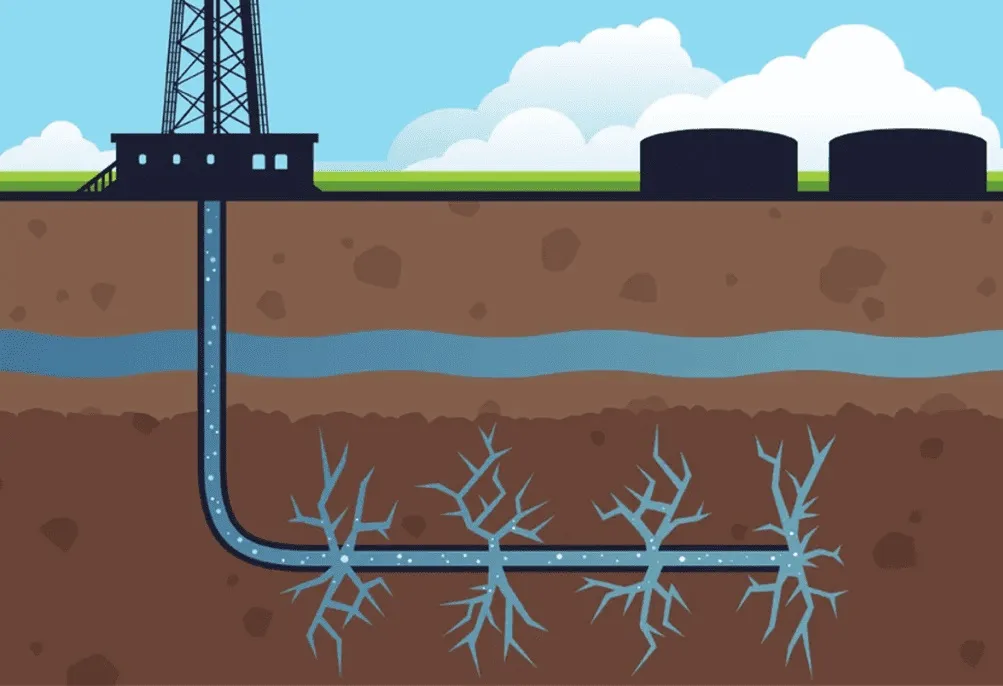
Hydraulic fracturing — fracking, in the field — is a well stimulation technique used to extract oil and natural gas from low-permeability subsurface formations. The process involves injecting fluid at pressures sufficient to initiate and propagate fractures in the target rock, creating conductive pathways that allow hydrocarbons to flow more freely to the wellbore. This article examines the core techniques of hydraulic fracturing, its production benefits, and the environmental considerations that must be managed responsibly.
Techniques of Hydraulic Fracturing
-
Preparation and Site Selection: It starts with the rock. Candidate formations get a geological and geomechanical evaluation before anyone moves a rig — subsurface data including well logs, core analysis, seismic surveys, and reservoir pressure measurements. What you're looking for is sufficient hydrocarbon saturation, adequate rock brittleness, and favorable in-situ stress orientations. Once a location is confirmed, the surface is prepared and drilling equipment is mobilized in accordance with applicable regulatory permits.
-
Drilling: A well is drilled vertically to the target depth. In tight formations such as shale that commonly reaches 8,000–15,000 feet true vertical depth (TVD). From there, a build section transitions the wellbore to a near-horizontal orientation so the lateral can be placed within the productive interval, with lateral sections extending 5,000–15,000+ feet measured depth (MD). Horizontal laterals maximize contact with the reservoir and are now standard practice in unconventional development. Wellbore integrity — including casing design and cement placement — is critical at this stage to isolate the producing zone from shallower formations and groundwater aquifers.
-
Fracturing Fluid Injection: Once the well is cased, perforated, and pressure-tested, fracturing fluid is pumped into the isolated interval at rates and pressures sufficient to exceed the formation's fracture gradient. The fluid is predominantly water, combined with a proppant — most commonly silica sand or ceramic beads — to hold fractures open after pressure is released, and a relatively small volume of chemical additives that serve functions such as friction reduction, scale inhibition, and biocide control. The specific fluid design is tailored to formation mineralogy, temperature, and reservoir pressure.
-
Flowback and Production: Pumping stops, wellbore pressure is released, and a portion of the injected fluid returns to surface as flowback water, along with formation water produced from the reservoir. Flowback is collected in lined tanks or pits, characterized, and either treated for reuse in subsequent fracturing operations or disposed of through permitted methods. The well then transitions to the production phase, where hydrocarbons are separated, metered, and transported.
-
Monitoring and Management: Continuous monitoring throughout the operation is essential. Real-time surface treating pressure, rate, and proppant concentration data are tracked to confirm the fracture is propagating as designed. Microseismic monitoring or tiltmeter arrays are sometimes deployed to map fracture geometry. Post-job pressure decline analysis provides diagnostic information on fracture closure and conductivity. Regulatory requirements for well integrity testing and environmental monitoring vary by jurisdiction but are a standard component of responsible operations.
Benefits of Hydraulic Fracturing
-
Increased Energy Production: Hydraulic fracturing, combined with horizontal drilling, unlocked vast volumes of oil and natural gas from tight and shale formations that were previously considered uneconomic, contributing to greater energy supply diversity.
-
Economic Growth: Development of unconventional resources through hydraulic fracturing supports employment across a wide range of disciplines — drilling, completions engineering, fluid logistics, environmental services, and pipeline infrastructure — as well as indirect economic activity in host communities.
-
Lower Carbon Emissions Relative to Coal: Natural gas produced through hydraulic fracturing burns more cleanly than coal for power generation, producing less carbon dioxide per unit of energy at the point of combustion. The catch: the full lifecycle greenhouse gas benefit depends critically on controlling methane emissions throughout the production and gathering system.
-
Technological Advancements: The operational demands of large-scale unconventional development have driven meaningful advances in drilling efficiency, completion design, real-time data acquisition, and produced water management, many of which have broader applications across the industry.
Environmental Impacts of Hydraulic Fracturing
-
Water Usage: A hydraulic fracturing treatment requires substantial volumes of water, and multi-well pad development in a single area can place meaningful demand on local surface water or groundwater sources. In water-stressed regions, this requires careful planning, permitting, and coordination with other water users. Operators increasingly pursue produced water recycling to reduce freshwater withdrawals.
-
Chemical Contamination: Fracturing fluid additives include chemicals with varying toxicity profiles. The primary risk pathway for groundwater contamination is loss of wellbore integrity — inadequate casing or cement — rather than fracture propagation itself. Vertical separation between the target formation and potable aquifer zones is a critical design parameter and must be verified through site-specific geological and hydrogeological assessment. Proper well construction, pressure testing, and regulatory oversight are the primary safeguards.
-
Air Quality Concerns: Operations can release volatile organic compounds (VOCs) and methane during flowback, production, and fluid handling. Flaring and venting are sources of both greenhouse gas emissions and local air quality impacts. Reduced emission completions (also called green completions), vapor recovery units, and leak detection and repair (LDAR) programs are established practices for controlling these emissions, and are required under various regulatory frameworks.
-
Seismic Activity: Induced seismicity associated with oil and gas operations is most commonly linked to the subsurface disposal of large volumes of produced water via Class II injection wells. Hydraulic fracturing can also induce microseismic events — very small magnitude events generated as a normal consequence of rock failure — and, in specific geological and stress settings, larger magnitude events, though felt seismicity directly from fracturing is less common than from disposal operations. Rules in some jurisdictions require operators to reduce injection rates or cease operations if seismic thresholds are exceeded.
-
Habitat Disruption: Surface disturbance from well pad construction, access roads, pipelines, and associated infrastructure can fragment habitats and affect local wildlife. Reclamation planning and progressive restoration are standard components of responsible site management.
Conclusion
Hydraulic fracturing has fundamentally changed the economics and scale of oil and gas production from tight and unconventional formations, delivering real benefits in terms of energy supply and economic activity. At the same time, the technique carries genuine environmental responsibilities — particularly around well integrity, water management, air emissions, and surface disturbance — that require rigorous engineering, transparent regulatory oversight, and ongoing operational improvement. As completion technology, produced water treatment, and emissions monitoring continue to advance, the industry's ability to develop these resources with a reduced environmental footprint improves. Sustained engagement between operators, regulators, researchers, and affected communities remains essential to managing the trade-offs responsibly.
(Editor's note: the approved draft carried no fenced json metadata block, so none appears here.)