The oil and gas industry remains a cornerstone of the global energy supply, driving economic activity and providing feedstocks for a wide range of downstream industries. However, its infrastructure — from extraction sites and processing facilities to pipelines and terminals — generates significant environmental and economic consequences across its entire service life. A comprehensive lifecycle analysis (LCA) of oil and gas infrastructure examines these consequences from construction through operation to decommissioning, providing a structured basis for sustainability planning and capital allocation. This article explores the environmental and economic dimensions at each phase and highlights why integrating LCA into strategic decision-making matters.
Understanding Lifecycle Analysis in Oil and Gas
Lifecycle analysis is a systematic methodology for evaluating the environmental aspects and potential impacts associated with a product, process, or service across all stages of its existence. In the context of oil and gas infrastructure, LCA quantifies the cumulative effects of design choices, construction methods, operational practices, and end-of-life strategies. This enables operators, regulators, and investors to make informed decisions that balance economic objectives with environmental stewardship. The ISO 14040 and ISO 14044 standards provide the internationally recognised framework for conducting and reporting LCA studies.
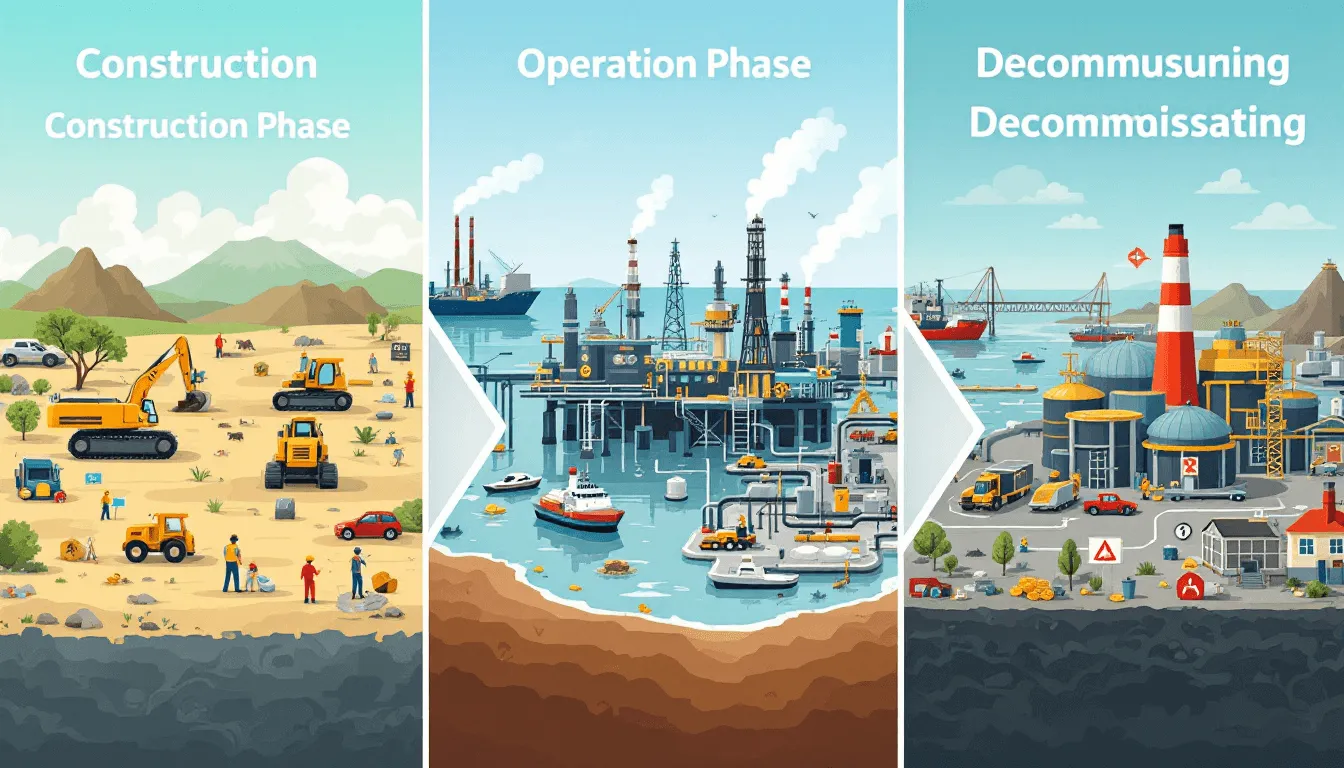
Construction Phase
Environmental Aspects
The construction of oil and gas infrastructure involves substantial environmental disturbance. Land clearing for drilling pads, pipeline rights-of-way, and processing facilities causes habitat fragmentation and biodiversity loss. Earthworks and soil disturbance increase the risk of erosion and sedimentation in adjacent water bodies. Operation of heavy construction equipment generates air emissions and noise. The manufacture, transport, and installation of structural steel, concrete, and other materials all contribute to the project's embodied greenhouse gas (GHG) footprint.
Economic Aspects
The construction phase demands significant upfront capital. Expenditures cover materials procurement, civil and mechanical labour, equipment mobilisation, and regulatory compliance activities including environmental impact assessments. Schedule overruns driven by permitting delays, community consultation requirements, or adverse ground conditions can materially increase project costs. On the positive side, construction activity can stimulate regional economies through direct employment and demand for local goods and services.
Operation Phase
Environmental Aspects
During operation, oil and gas infrastructure generates ongoing environmental pressures. Routine and fugitive emissions of volatile organic compounds (VOCs) and methane contribute to local air quality degradation and global warming. Flaring of associated gas, where gas handling infrastructure is absent or constrained, produces combustion products including carbon dioxide, black carbon, and unburned hydrocarbons. Accidental releases — oil spills, well blowouts, or pipeline ruptures — pose acute risks to soil, surface water, and groundwater. Water-intensive operations such as hydraulic fracturing place demands on local freshwater resources and generate produced water requiring treatment or disposal.
Economic Aspects
Operational efficiency is a primary determinant of project economics. Operating expenditures encompass maintenance, inspection, labour, energy consumption, chemical usage, and regulatory compliance. Well-executed integrity management programmes extend asset life and protect revenue streams. Conversely, unplanned shutdowns caused by equipment failure or environmental incidents generate direct repair costs, production deferral, regulatory penalties, and reputational damage that can affect future permitting and social licence to operate.
Decommissioning Phase
Environmental Aspects
Decommissioning encompasses the safe removal or abandonment of infrastructure and the restoration of affected sites. Executed properly, it can substantially reduce long-term environmental liabilities. Key activities include well plugging and abandonment, removal or in-place decommissioning of facilities, hazardous materials management, soil and groundwater remediation, and ecological restoration. Inadequate decommissioning leaves a legacy of soil contamination, orphaned equipment, and ongoing leakage risk that can persist for decades.
Economic Aspects
Decommissioning represents a material cost obligation that must be recognised and provisioned for throughout asset life. Expenditures cover well abandonment, structural demolition, waste classification and disposal, site remediation, and regulatory verification. Early financial planning — including the establishment of decommissioning funds or surety instruments — is essential to ensure that resources are available when obligations fall due. Opportunities exist to recover value through material recycling, equipment reuse, and site repurposing, which can partially offset gross decommissioning costs.
Integrating Environmental and Economic Considerations
Environmental responsibility and economic viability are not opposing objectives — they are interdependent. Proactive investment in emission reduction, integrity management, and responsible water stewardship reduces the probability of costly incidents and regulatory enforcement actions. Technologies that improve energy efficiency lower both operating costs and the carbon intensity of production. LCA provides the analytical framework to identify where targeted investments yield the greatest combined environmental and economic benefit across the full asset lifecycle.
Regulatory Framework and Compliance
Regulatory requirements apply at every stage of infrastructure life. Environmental impact assessments are typically mandatory before construction approvals are granted. Operational permits impose emission limits, discharge standards, and monitoring obligations. Decommissioning regulations specify well abandonment standards, site remediation criteria, and financial assurance requirements. Non-compliance exposes operators to fines, licence suspension, civil liability, and reputational harm — all of which carry direct economic consequences.
Advancements in Sustainable Technologies
Technological innovation continues to expand the options available for reducing environmental impact while maintaining or improving economic performance. Key examples include:
- Carbon Capture and Storage (CCS): Captures CO₂ from processing and combustion sources and sequesters it in geological formations, reducing the net GHG intensity of operations.
- Leak Detection and Repair (LDAR): Systematic programmes using optical gas imaging, continuous monitoring sensors, and drone-based surveys detect and eliminate fugitive emissions, reducing both product loss and environmental harm.
- Renewable Energy Integration: Electrification of compression, pumping, and facility loads using grid-supplied or on-site renewable power reduces combustion emissions and fuel operating costs.
Case Studies
Case Study 1: Offshore Oil Rig Decommissioning
An offshore installation in the North Sea was decommissioned with environmental restoration as a primary planning objective. Early engagement with environmental consultants and regulators allowed the operator to develop a decommissioning programme that minimised seabed disturbance, managed hazardous materials appropriately, and maximised the proportion of structural steel and equipment directed to recycling or reuse, reducing net waste disposal costs.
Case Study 2: Pipeline Construction Optimisation
A pipeline project in North America adopted horizontal directional drilling (HDD) to cross sensitive riparian and wetland areas rather than open-cut trenching. Although HDD carried a higher unit cost for the crossing sections, it avoided the habitat disturbance, erosion risk, and potential regulatory and legal challenges associated with conventional methods, producing a better overall outcome on both environmental and total project cost metrics.
Conclusion
A lifecycle analysis of oil and gas infrastructure demonstrates that environmental and economic considerations are deeply interconnected at every project phase. By systematically evaluating cumulative impacts from construction through operation to decommissioning, operators and planners can identify strategies that reduce environmental harm while protecting and enhancing economic returns. Sustainable design choices, rigorous operational integrity management, proactive decommissioning planning, and adoption of proven emission-reduction technologies are all essential components of a responsible and commercially resilient approach to oil and gas infrastructure management.