Onshore vs. Offshore Oil Production: A Comparative Engineering Overview
Pick the wrong production strategy for a reservoir and the damage doesn't stop at capital cost. Operating expenditure climbs for the life of the asset. Safety exposure compounds over decades. And procurement teams inherit complexity long after the engineers who signed off on the original decision have moved on. The fundamental divide between onshore and offshore production isn't just geography. It's engineering philosophy, risk profile, regulatory burden, and infrastructure logic — and it touches every discipline from drilling to decommissioning.
This article is written for engineers and procurement leads who need a working framework for comparing the two environments. Not a textbook survey. A decision-relevant reference you can actually use.
Engineering Environment and Design Drivers
Onshore
Onshore production sits on terrain you can drive a truck across. Logistics, maintenance, and emergency response are relatively unconstrained. Land rigs, pumpjacks on mature wells, surface gathering systems, tank farms, and workover units all travel by road. The design envelope is defined by reservoir characteristics, regulatory setbacks, and surface land constraints — not by structural or marine loading.
Here's what matters most: when equipment fails onshore, you can usually recover within a manageable timeframe. A failed pump gets swapped out by a crew that drove to the site. A wellhead integrity issue gets isolated with surface valves and personnel on-site within hours. That accessibility shapes the entire maintenance philosophy. Corrective and preventive intervals can be tightened or loosened based on operational data without paying a logistical penalty.
Offshore
Offshore production stacks a second engineering problem on top of the reservoir problem. The platform or vessel itself has to survive the marine environment while simultaneously running as a process facility. Jack-ups handle shallow water. Semi-submersibles and drillships operate in deeper water. Fixed platforms and floating production, storage, and offloading (FPSO) units manage production at varying water depths. Subsea trees and risers add a third layer of complexity below the waterline.
Every equipment selection offshore carries a weight penalty, a corrosion penalty, and an access penalty. What would be a half-day job onshore can require a helicopter mobilisation, a marine crew change, and a permit-to-work cycle that stretches across multiple days. That's not an inconvenience. It's a cost and risk driver that has to be built into the asset's lifecycle model from day one.
Drilling Technology and Well Architecture
A detailed comparative analysis of drilling technology across both environments is provided in the literature (WJARR, 2024, 22(2)). The key distinctions are worth pulling out:
Directional drilling shows up in both environments, but offshore it does more work. Multiple wells drilled from a single platform or subsea template shrink the surface footprint and cut the number of expensive marine structures needed. Onshore, directional drilling is mostly about reservoir access — and increasingly, horizontal completions in tight formations.
Well control equipment follows the same core principles in both places — blowout preventers, choke and kill lines, well monitoring — but offshore BOP stacks carry extra complexity. Riser management, subsea pressure differentials, remote operation — all of it has to be addressed. The applicable well control standards must account for these differences explicitly.
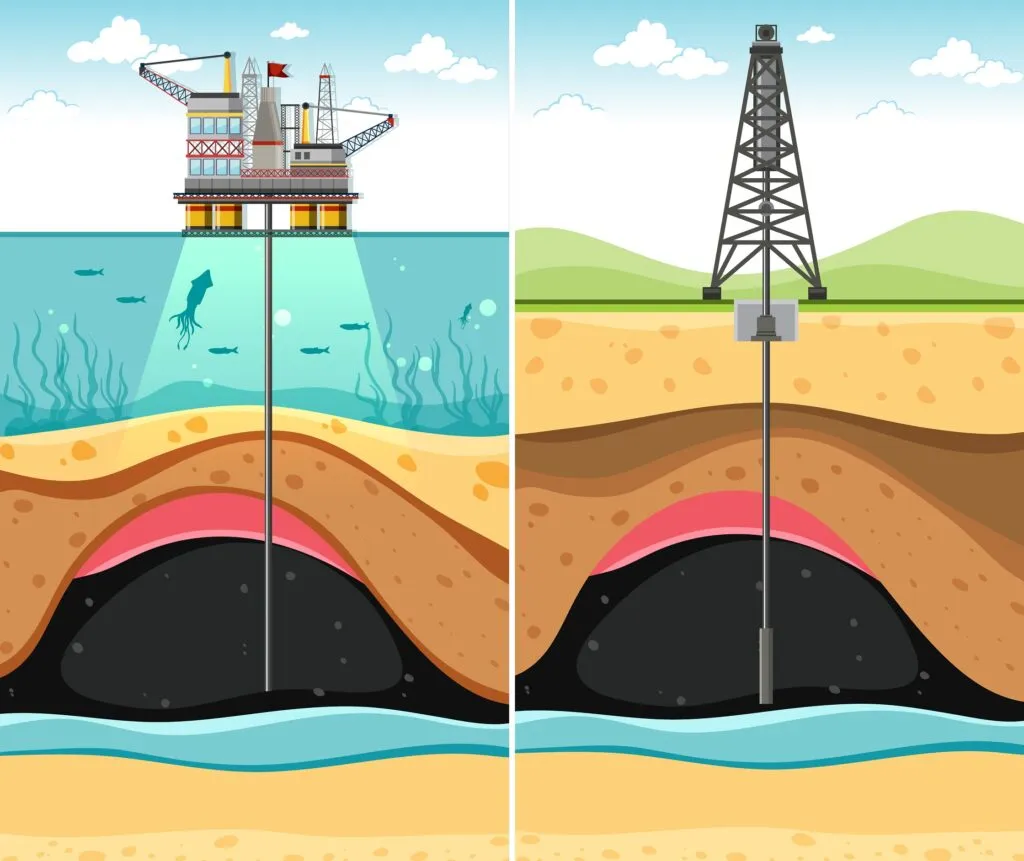
Completion and production systems diverge sharply. Onshore wells use surface wellheads and conventional Christmas tree configurations you can walk up to and intervene on directly. Offshore subsea completions put the wellhead on the seabed. That means remotely operated vehicles (ROVs) for intervention and strict reliability requirements on every component — because the cost of unplanned intervention offshore is orders of magnitude higher than onshore.
Infrastructure and Facility Engineering
| Parameter | Onshore | Offshore |
|---|---|---|
| Primary structure | Concrete or steel surface pad | Fixed platform, FPSO, semi-sub, or jack-up |
| Process equipment access | Road and crane | Helicopter, vessel, or ROV |
| Corrosion environment | Atmospheric; soil-side for buried pipe | Marine atmospheric; splash zone; subsea |
| Power supply | Grid connection feasible | Self-generated; weight-critical |
| Water handling | Surface disposal or injection | Overboard discharge (regulated) or injection |
| Emergency response | Public emergency services accessible | Self-contained; Coast Guard response times longer |
| Decommissioning | Wellhead plug and abandon; surface restoration | Platform removal; subsea infrastructure; regulatory complexity |
These differences aren't incremental — they're categorical. An FPSO carries its own power generation, water treatment, accommodation, helideck, and emergency systems as an integrated package. Every kilogram added to the topsides directly affects hull stability calculations. That drives a design discipline onshore engineers rarely deal with: mass budget.
Corrosion management makes the same point from a different angle. Onshore, atmospheric corrosion protection follows well-established coating and inspection regimes. Offshore, the splash zone — that band of alternating wet and dry exposure at the waterline — eats through coatings at accelerated rates. It demands specific coating systems, cathodic protection design, and inspection access planning that onshore practice simply doesn't cover. The applicable corrosion and materials standards have to be selected for the actual exposure zone, not adapted from land-based codes.
Safety, Regulation, and Standards
Safety engineering in both environments sits under layers of regulation and industry standards. But the baseline risk profile differs in ways that drive system design.
Functional safety systems in both environments are designed in accordance with IEC 61511 (Functional Safety — Safety Instrumented Systems for the Process Industry Sector) or equivalent sector-specific standards such as IEC 61508 (generic functional safety) and API RP 14C (offshore systems). These standards provide the framework for Safety Instrumented System design, SIL assignment, and verification. Offshore, though, critical functions like emergency shutdown and blowdown typically require higher Safety Integrity Levels (SIL). The consequence severity is simply greater. Process safety management frameworks, including hazard and operability studies (HAZOP) and layers of protection analysis (LOPA), apply in both environments but must be scoped to the specific consequence model of each.
Rotating equipment selection — pumps, compressors, and drivers — follows API 610 for centrifugal pumps and related API machinery standards in both environments. Offshore specs add weight limits, footprint constraints, and vibration requirements driven by the dynamic marine environment.
Any procedure that opens, depressurises, or inspects hydrocarbon-containing equipment in either environment must include: full isolation of the affected section, controlled depressurisation to a safe vent or flare system, verification of zero energy state by pressure gauge and bleed, lockout/tagout (LOTO) of all energy sources, hazardous-area precautions appropriate to the area classification, continuous or periodic gas detection during the work, and safe venting to atmosphere or closed system as required by the site safety case.
Cost Structure and Economic Logic
The cost structure difference between onshore and offshore runs deep, even without pinning specific numbers to it:
Onshore production carries lower capital expenditure per well and per unit of production capacity in most conventional plays. You can move equipment by road. Maintenance is more straightforward. Infrastructure gets built in phases as production comes online. That makes onshore development tolerant of phased investment and responsive to commodity price cycles.
Offshore demands large upfront capital commitment — the platform or FPSO gets built before first oil, no matter how production ramps. Operating costs per barrel sit structurally higher because of crew rotation, helicopter logistics, marine support vessels, and the sheer complexity of offshore maintenance. Offshore reservoirs, though, can be larger and higher-productivity in certain plays, which may justify the capital intensity when reservoir quality and commodity price support the economics.
The procurement implication is direct: offshore equipment specs are tighter, lead times are longer, and the cost of specifying incorrectly — then retrofitting or replacing equipment on an offshore structure — is disproportionately high compared to onshore. Front-end engineering and procurement strategy has to reflect this.
Illustrative Scenario: Equipment Selection Decision
This scenario is constructed for engineering guidance purposes.
Say a procurement team is evaluating centrifugal pump options for a produced water injection system. Onshore, the selection focuses on hydraulic performance, seal system, and vendor support. If the pump fails prematurely, a road crew swaps it out.
Offshore, the same evaluation has to cover more ground: total installed weight and footprint on the topsides deck, materials compatibility with the marine atmospheric environment, mean time between planned maintenance intervals — because unplanned intervention is costly — seal system suitability for the dynamic motion environment of a floating facility, and spare parts storage within the platform's limited inventory space. A pump that clears every onshore requirement can still fail multiple offshore-specific criteria. When procurement teams apply onshore specifications to offshore requisitions without adjustment, they introduce reliability and cost risk that surfaces years into production.
Decision Guidance Checklist
Before committing to a production development strategy or specifying equipment, work through the following:
Development strategy
- [ ] Is the reservoir accessible from surface with acceptable directional well reach, or does water depth require subsea infrastructure?
- [ ] Does the water depth and metocean environment require a fixed platform, jack-up, semi-sub, or FPSO?
- [ ] What is the realistic maintenance access frequency, and does the equipment selection reflect that interval?
Equipment and materials specification
- [ ] Have corrosion zone classifications (atmospheric, splash zone, submerged, buried) been assigned to all equipment and structures?
- [ ] Are rotating equipment specifications compliant with applicable API machinery standards and adjusted for offshore weight and motion constraints where relevant?
- [ ] Have SIL targets for safety instrumented functions been derived from a consequence model that reflects the specific offshore or onshore risk profile?
Procurement and supply chain
- [ ] Have offshore-specific documentation requirements (material traceability, third-party inspection, weight certification) been included in requisitions?
- [ ] Has the lead time for long-delivery offshore items been mapped against the project schedule?
- [ ] Is the spare parts strategy sized for the actual intervention frequency of the offshore location?
Safety and operations
- [ ] Does the safety case or hazard register reflect the consequence severity of the specific environment?
- [ ] Have isolation, depressurisation, LOTO, and gas detection procedures been developed for the specific facility layout?
- [ ] Is emergency response capacity (muster stations, lifeboats, helicopter landing) sized for maximum persons on board?
Conclusion
Onshore and offshore oil production aren't variations of the same engineering problem. They're distinct disciplines that share a common reservoir objective but diverge in almost every other dimension. Offshore imposes structural, corrosion, logistics, and safety constraints that demand purpose-built engineering responses — not scaled-up versions of land practice.
For practising engineers, the immediate next step is making sure the design basis for any project explicitly documents which environment-specific constraints apply — and that equipment specifications, maintenance philosophies, and safety cases flow from that basis rather than being carried over from a previous project in a different environment. For procurement teams, the priority is building offshore-specific technical requirements into requisitions before the RFQ stage, not as a post-award fix. Getting this right early always costs less than correcting it in the field.