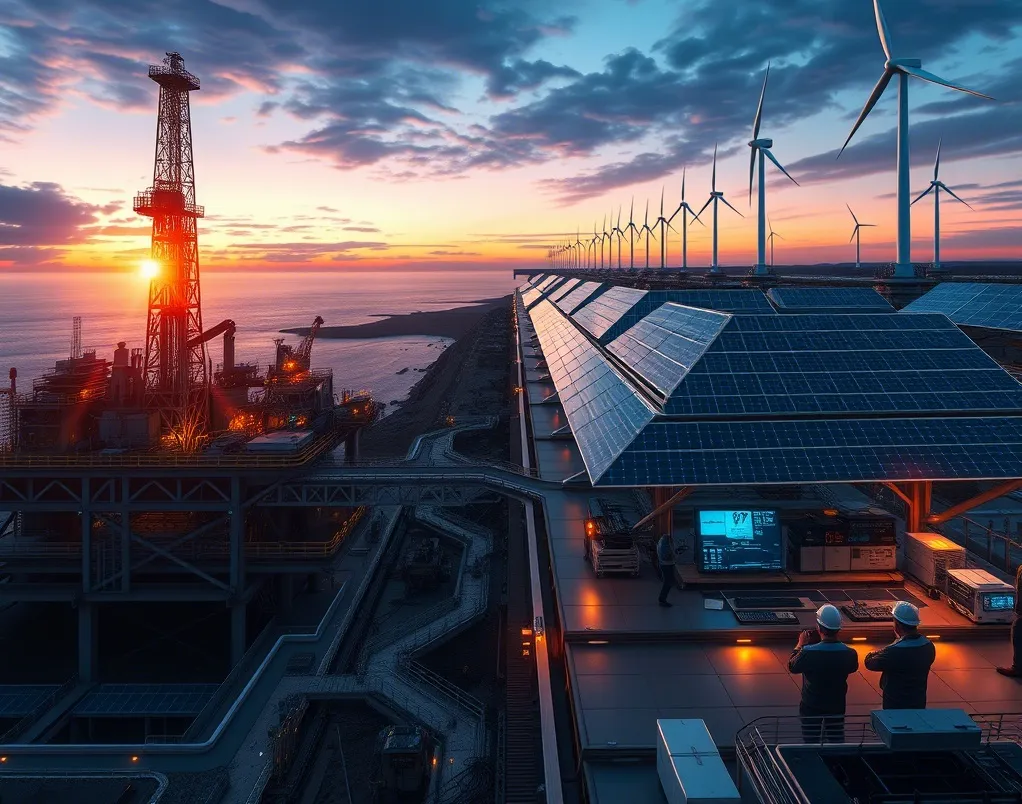
Preparing for the Future: Strategies for Oil and Gas Companies in a Changing Energy Landscape
The core operational problem facing oil and gas companies is not philosophical — it is financial and structural. Capital allocation decisions made today lock in asset portfolios, workforce compositions, and technology platforms for decades. A refinery optimised purely for high-sulphur crude, a workforce trained exclusively on conventional drilling, or an NOC balance sheet dependent on a single revenue stream each carry compounding risk as demand signals, policy frameworks, and financing conditions shift simultaneously. Companies that fail to build adaptive capacity now will face forced restructuring later, at higher cost and under worse conditions.
This article addresses the practical strategies that engineering, maintenance, and procurement teams need to understand — because the transition is not solely a boardroom matter. Field-level decisions on asset life extension, technology adoption, emissions management, and workforce capability directly determine whether a company's strategy succeeds or stalls.
The Operating Environment in 2026
Simultaneous Pressures
The Deloitte 2026 Oil and Gas Industry Outlook identifies three concurrent pressures: shifting policy environments, rising operating costs, and emerging opportunities — particularly in LNG. Bain & Company's 2026 analysis reinforces that success in this environment depends on disciplined focus on a limited number of fundamentals rather than attempting to respond to every market signal at once.
These pressures are not abstract. For a maintenance lead, rising costs mean tighter turnaround budgets against ageing infrastructure. For a procurement team, shifting policy means supplier qualification requirements that now include emissions disclosures. For an engineering team, new LNG opportunities mean fast-tracking projects while managing existing asset reliability.
The Dual Mandate
The IEA's analysis of the oil and gas industry in energy transitions makes clear that companies must simultaneously manage their existing hydrocarbon business and build capability for a lower-carbon future. These are not sequential tasks. McKinsey's analysis of oil and gas companies in renewable power echoes this: the companies most likely to succeed are those that leverage existing operational competencies — project execution, large-scale asset management, supply chain discipline — rather than treating the energy transition as an entirely separate business.
TrueContext's field service strategy analysis frames this practically: maximise returns from current operations while systematically preparing the organisation for a different energy mix. Walking away from core production prematurely destroys value; ignoring transition risk entirely creates stranded asset exposure.
Strategic Options and Their Operational Implications
Option 1: Optimise and Extend Core Operations
For many companies, particularly those with competitive cost structures, the near-term priority is wringing maximum value from existing assets while reducing emissions intensity. integrity management programmes aligned with applicable standards such as API 510 (in-service inspection, rating, repair, and alteration of pressure vessels) and API 570 (in-service inspection, repair, alteration, and rerating of piping systems)
- Process safety management frameworks consistent with
API RP 750and applicable national regulations, recognising that cost pressure should never erode process safety margins. - Emissions reduction at the asset level — methane detection, flare minimisation, and compression efficiency — which simultaneously reduces operating cost and regulatory exposure.
For engineering teams, this translates to a concrete need: develop decommissioning competency alongside production competency. These are different engineering disciplines, and building them now is less expensive than hiring externally under time pressure.
Option 2: Diversify Into Adjacent Low-Carbon Business
The KPMG transition planning guidance recommends that oil and gas companies identify where their existing capabilities create a genuine competitive advantage in adjacent markets, rather than entering new sectors where they have no edge. The most credible adjacencies include:
| Adjacent Sector | Transferable O&G Capability | Key Gap to Address |
|---|---|---|
| LNG infrastructure | Pipeline engineering, compression, cryogenic handling | Regulatory navigation in new markets |
| Carbon capture and storage | Subsurface characterisation, well integrity, injection operations | Long-term liability frameworks |
| Hydrogen production and transport | Compression, pipeline materials, safety management systems | Embrittlement standards, blending limits |
| Offshore wind (installation/O&M) | Marine logistics, heavy lift, remote operations | Electrical systems, turbine-specific maintenance |
Note: No cost or performance figures are assigned to these adjacencies — qualification depends on company-specific capability assessments.
No fix required if the source is verified to exist and contain this claim. If the source cannot be verified, remove the specific attribution and reframe as general principle: 'For NOCs specifically, diversification decisions must account for the host government's fiscal dependence on hydrocarbon revenues, as capital diversion to renewables while national budgets remain dependent on oil royalties creates unsustainable mismatches.' makes an important distinction for NOCs specifically: diversification decisions must account for the host government's fiscal dependence on hydrocarbon revenues. An NOC that diverts capital to renewables while the national budget remains dependent on oil royalties creates a mismatch that neither the company nor the government can sustain. Engineering and procurement teams working within NOC structures should expect that capital allocation decisions will carry political as well as technical constraints.
Option 3: Portfolio Rationalisation
Bain's 2026 analysis is explicit: in a disruptive environment, trying to do too many things simultaneously destroys value. Portfolio rationalisation — divesting high-cost, high-emission, or technically complex assets that no longer meet return thresholds — is a legitimate and often underutilised strategy.
For operations teams, this means asset condition assessments need to be framed not just as maintenance decisions but as divestiture inputs. A well-documented integrity baseline, current inspection records, and a clear remaining-life estimate materially affect the value realised in a sale. Conversely, deferred maintenance that is not disclosed creates post-transaction liability.
Workforce and Technology Capability
Skills the Organisation Needs Now
The energy transition does not replace oil and gas engineering skills — it extends them. Subsurface engineers who understand reservoir behaviour are directly applicable to CCS site characterisation. Rotating equipment specialists who manage compressors are directly applicable to hydrogen compression trains. Corrosion engineers who manage H₂S environments have transferable knowledge for hydrogen embrittlement assessment.
What companies must add is capability in:
- Electrical systems integration (for electrification of field operations)
- Digital instrumentation and data analytics (for predictive maintenance and emissions monitoring)
- Low-carbon project development and permitting
KPMG's transition planning guidance recommends that workforce capability assessments be conducted before capital commitments are made in new sectors. Hiring talent into a business that lacks the organisational infrastructure to deploy it effectively wastes both the capital and the people.
Digital Tools and Reliability
Digital investment should be evaluated against a clear operational question: does this tool reduce unplanned downtime, improve inspection quality, or lower emissions? Tools that cannot be connected to one of these outcomes are difficult to justify in a constrained capital environment.
Predictive maintenance platforms, remote monitoring of rotating equipment, and automated emissions leak detection all meet this test. They also generate the data that regulators and financiers increasingly require. Procurement teams should ensure that digital platform contracts include data portability provisions — vendor lock-in on operational data is a long-term liability.
Illustrative Scenario: Mid-Size E&P Company Facing Asset Life Decisions
The following is illustrative and not drawn from a named company or project.
A mid-size E&P operator with a portfolio of maturing offshore assets faces declining well productivity and increasing integrity management costs. The engineering team completes a fitness-for-service review across the portfolio and segments assets into three categories: assets with remaining productive life sufficient to justify continued investment, assets approaching end-of-life where only minimal sustaining capital is warranted, and assets where decommissioning planning should begin immediately.
Simultaneously, the company identifies that its subsurface and well integrity teams have skills directly applicable to CCS well design. Rather than building a separate CCS business unit, it pilots a small internal CCS project using existing personnel, treating it as a capability development exercise rather than a major capital commitment.
The procurement team, meanwhile, begins qualifying suppliers who can provide both conventional well services and CCS-related services, reducing the number of framework agreements while broadening their scope. This reduces administrative overhead and creates supplier relationships that support both the current and future business.
Decision Checklist for Engineering, Maintenance, and Procurement Teams
Use this checklist to assess whether your organisation's operational decisions are aligned with a coherent transition strategy:
Asset Management
- [ ] Has a current fitness-for-service assessment been completed for all major assets, consistent with applicable
API 510,API 570, or equivalent standards? - [ ] Are decommissioning cost estimates included in asset life-cycle models?
- [ ] Is emissions data (methane, flaring, venting) captured at asset level and reported accurately?
Capital Projects
- [ ] Does each new capital project have a defined carbon intensity target alongside cost and schedule targets?
- [ ] Have supply chain emissions (Scope 3) been considered in major procurement decisions?
- [ ] Is the project team capable of executing, or does it require capability that does not yet exist in-house?
Workforce
- [ ] Has a skills gap assessment been completed against the company's stated strategy?
- [ ] Are training programmes building capability in both current operations and adjacent sectors?
Procurement and Supply Chain
- [ ] Do supplier qualification requirements include emissions management and safety performance criteria?
- [ ] Are framework agreements structured to accommodate scope expansion into adjacent sectors?
Strategy Alignment
- [ ] Is the company's stated strategy — optimise, diversify, or rationalise — reflected in actual capital allocation?
- [ ] Are operational teams aware of the strategic rationale behind current investment priorities?
Conclusion and Next Steps
The companies that will perform well through this transition are not those that abandon hydrocarbons prematurely or those that ignore transition risk entirely. They are the ones that apply the same operational discipline to strategic adaptation that they apply to well integrity and process safety: systematic assessment, clear decision criteria, and execution that matches the plan.
For engineering and maintenance leads, the immediate next step is to ensure that asset condition data is current, complete, and structured in a way that supports both operational decisions and strategic portfolio reviews. For procurement teams, the priority is building supplier relationships that are flexible enough to support a business that may look different in ten years.
Bain's 2026 guidance is a useful anchor: focus on a few fundamentals and execute them well. In operational terms, that means reliable production, controlled costs, credible emissions management, and a workforce that is building capability for what comes next. None of these require waiting for strategic clarity at the board level — they can and should begin now.