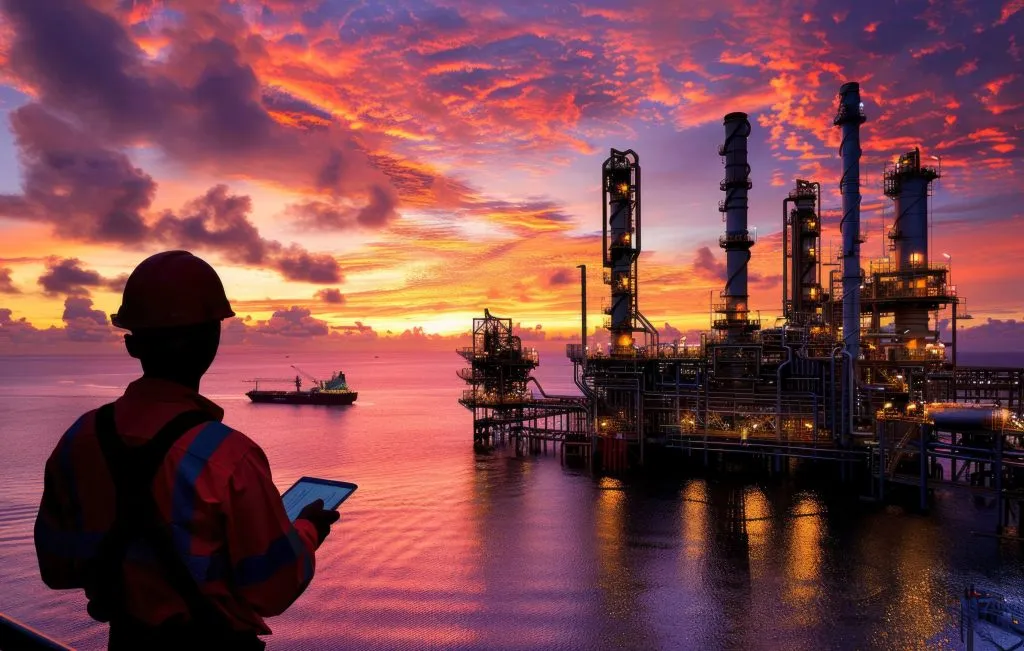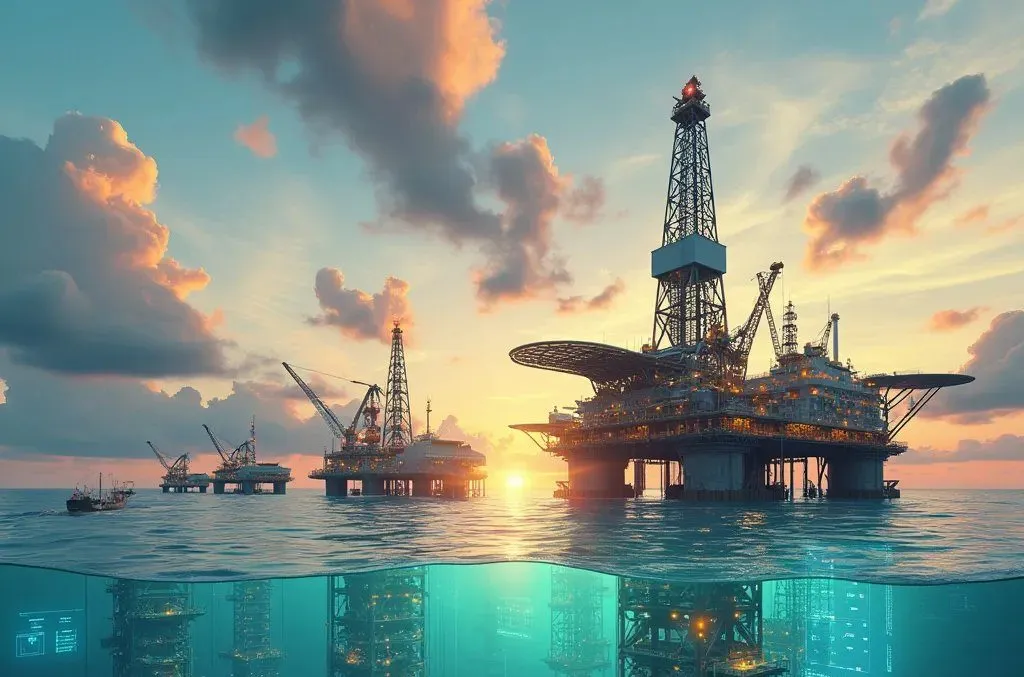
The Evolution of Offshore Drilling Technology: From Pier-End Wells to Deepwater Frontiers
Drilling for hydrocarbons beneath open water presents a deceptively simple problem: the reservoir doesn't care that several hundred or several thousand metres of seawater sit above it. The equipment, the people, and the logistics have to. Every increment in water depth multiplies the mechanical complexity, the well-control risk, and the capital exposure. Understanding how the industry solved each successive depth barrier is not academic history — it directly informs how procurement teams specify rigs today, how maintenance leads plan intervention windows, and how engineers assess whether a legacy asset is fit for a modern campaign.
From Piers to Purpose-Built Platforms: The First Century
The offshore industry's origins are more modest than the deepwater giants that dominate current headlines. The first offshore wells were drilled from wooden piers extending into shallow coastal waters, most notably at Summerland, California, where late-nineteenth-century operators simply extended land-drilling practice over the surf zone. The pier provided a stable work surface; the well was essentially a land well with wet feet.
That model could not scale. Pier construction became prohibitively expensive as water depth increased, and the structures were vulnerable to weather and marine traffic. The industry's response, developed through the first half of the twentieth century, was the fixed-bottom structure: a steel jacket piled into the seabed and topped with a production deck. This approach proved durable.
The critical constraint of the fixed platform is geological and economic: at some water depth, the steel tonnage required to resist wave loading and maintain structural integrity becomes uneconomical. That threshold drove the development of every floating concept that followed.
The Post-War Acceleration
The National Commission on the BP Deepwater Horizon Oil Spill documented how offshore activity expanded dramatically after World War II, when the combination of onshore depletion pressure, improved marine engineering, and government leasing programmes pushed operators into the Gulf of Mexico in earnest. The first true offshore lease sales in federal waters occurred in the early 1950s, and the industry moved quickly from state-jurisdiction nearshore acreage into deeper federal waters.
Provide the full citation including publication year: 'As noted in the 1986 OTC paper [Author(s), title, OTC 5354-MS, Offshore Technology Conference, Houston, TX, May 1986]' or confirm the actual year and update both the draft and the source list., the pace of technical change that had been gradual through the first half of the twentieth century effectively exploded in the decades that followed. The drivers were straightforward: reservoir quality in accessible shallow water was declining, and the prize reservoirs were in progressively deeper water.
Floating Drilling Systems: The Depth Barrier Breaks
Submersibles and Semi-Submersibles
The first floating drilling units were submersible barges — vessels that could be ballasted down to rest on the seabed in shallow water, providing a stable drilling platform without piling. Their depth range was limited by the requirement to touch bottom.
The semi-submersible configuration decoupled stability from seabed contact. By ballasting the lower pontoons below the wave-active zone while keeping the upper deck in air, the semi-sub dramatically reduced the motion response to wave action. This was a genuine enabling technology: it allowed drilling in water depths that fixed platforms could not economically reach, and in sea states that would have made barge operations impractical.
Column-stabilised semi-submersibles became the workhorse of deepwater exploration and remain so today. Their mooring systems evolved from conventional wire-and-chain spread moorings to dynamic positioning (DP) systems, which use thruster arrays and real-time position feedback to hold station without anchors — critical in water depths where anchor chain length becomes impractical.
Drillships
The drillship offers the mobility of a vessel with a drilling capability accessed through a central moonpool. Early drillships suffered from motion-induced problems: heave, pitch, and roll all translate directly into tension and fatigue loading on the drill string. Improvements in hull design, heave-compensated top drives, and DP capability progressively made drillships competitive with semi-subs for deepwater work, and their transit speed gives them an economic advantage in widely-spaced exploration programmes.
Jack-Up Rigs
In shallow to moderate water depths, the jack-up rig — a barge that extends legs to the seabed and elevates its hull clear of the waterline — provides a fixed work platform without permanent installation. Jack-ups dominate the shallow-water drilling market. Their operational envelope is defined by leg length, leg penetration into the seabed, and the environmental loading the elevated hull can sustain. Procurement teams specifying jack-ups for a campaign must verify that the unit's leg length and preload capacity are matched to the actual soil conditions at each location, not just the nominal water depth.
Subsea Systems: Moving the Wellhead to the Seabed
As water depth increased beyond what a surface-wellhead completion could practically serve, the industry developed the subsea wellhead and Christmas tree. Placing pressure-containing equipment on the seabed and connecting it to a floating host via flexible flowlines and umbilicals was a significant engineering step: it required reliable remote intervention, pressure-rated connectors that could be made up by ROV, and control systems that could function reliably at depth and temperature.
Replace 'the applicable API well-control standard' with specific standard numbers, e.g., 'API RP 65 (Care and Use of Subsea Equipment) and API RP 53 (Blowout Prevention Equipment Systems for Drilling Wells), in their current revision' or cite the specific standards applicable to the jurisdiction and well type.
Directional Drilling and Extended Reach
Water depth is only one dimension of the offshore drilling challenge. Reservoir geometry, platform footprint constraints, and the economics of subsea tiebacks all reward the ability to drill wells that deviate significantly from vertical. Directional drilling, enabled by downhole motors and later by rotary steerable systems, allows a single surface location to access multiple reservoir targets. Extended-reach drilling (ERD) pushes this to the point where the horizontal departure from the surface location may substantially exceed the vertical depth.
Either (1) provide the full article title and confirm the source makes the specific claim about MWD/LWD and geosteering, or (2) remove the attribution to this source and cite it only if the claim is directly supported by the text. If the claim is general industry knowledge, remove the source attribution entirely. and reducing the number of surface slots or subsea wellheads required to drain a given reservoir volume. MWD and logging-while-drilling (LWD) tools transmit real-time formation data to surface, allowing geosteering — the practice of adjusting wellbore trajectory in response to formation feedback to keep the well within the productive interval.
Automation, Digitalization, and Well Monitoring
Modern offshore rigs integrate a range of automated systems that reduce the manual handling of tubulars and drill string components — one of the highest-risk activities in drilling operations. Automated pipe-handling systems, iron roughnecks, and top-drive technology have reduced the exposure of personnel to the drill floor during tripping operations.
Real-time data transmission from downhole tools, combined with surface data acquisition systems, now allows drilling performance to be monitored and optimised from onshore support centres. AVEVA and similar industrial software providers have documented how digital integration of drilling data streams enables faster identification of drilling dysfunction — stick-slip, bit bounce, and washouts — that would previously have been identified only through lagging indicators such as bit wear or reduced penetration rate.
Well integrity monitoring during drilling, and subsequently during production, draws on sensor data from multiple barriers.
Practical Scenario (Illustrative)
Consider a deepwater semi-submersible drilling a pre-salt exploration well in water depths requiring a long-string riser. The BOP stack is landed on the subsea wellhead. During a connection, the MWD tool transmits a sustained increase in annular pressure that does not correlate with the expected equivalent circulating density. The driller observes that pit volume is trending upward. These two indicators — anomalous downhole pressure and surface pit gain — are the primary early-kick indicators. The well-control procedure requires the driller to immediately pick up off bottom, flow-check the well with pumps off, and if flow is confirmed, initiate shut-in using the annular preventer before notifying the company man. The sequence matters: premature or incorrect response can worsen a well-control situation as readily as delayed response.
Decision and Procurement Checklist
Before committing to a rig for an offshore campaign, the following should be verified:
- Water depth rating confirmed against the actual well location, including any seafloor topographic variation
- BOP stack configuration and test records reviewed against the well programme's well-control requirements and the applicable API well-control standard
- DP class certification (for dynamically positioned units) confirmed current and applicable to the environmental conditions at the location
- Riser system rated working pressure and fatigue life assessed against the planned well programme
- MWD/LWD tool suite confirmed to provide the formation evaluation data required by the geological programme
- Automated pipe-handling capability assessed against the planned tubular programme and crew competency
- Subsea control system umbilical length and response time verified against the tree and BOP control requirements
- Third-party well-control equipment certification confirmed current before rig mobilisation
Conclusion
The progression from pier-end wells to dynamically positioned drillships operating in deepwater is a story of solving successive depth, stability, and well-control problems with engineering rather than retreating from the resource. The fundamental well-control principles have not changed: detect an influx early, shut the well in, and circulate out the kick safely. What has changed is the mechanical and electronic capability available to execute those steps reliably at greater depth and in more hostile environments.
For practising engineers and procurement teams, the practical next step is straightforward: match the rig capability — water depth, BOP configuration, riser design, and automation level — to the specific well programme requirements before mobilisation, not after. Reviewing the current revision of applicable API and NORSOK well-control and well-integrity standards should be a standing item in every well-programme review, not a one-time exercise.