Maximizing Gas Turbine Efficiency in Offshore Platforms: Combustion Tuning & Compressor Washing
Offshore gas turbines don't degrade politely. On a platform where a single train may supply all power and compression for production, a gradual slide in thermal efficiency translates directly into higher fuel gas consumption, elevated exhaust temperatures, and — left unmanaged — accelerated hot-section wear. Two things you can actually control drive most of that slide: compressor fouling and combustion drift. Neither is exotic. Both are well understood. The gap between knowing and acting is usually a maintenance schedule that was set at commissioning and never revisited against actual operating data.
The Offshore Operating Environment and Why It Accelerates Degradation
Salt aerosols, hydrocarbon mist, platform exhaust recirculation, and the variable humidity of marine environments. Put together, they create an intake air quality that is fundamentally different from an onshore industrial site. Research on a fleet of GE LM2500 engines operating at Statoil offshore facilities confirmed that compressor fouling is the dominant performance degradation mechanism in this environment, and that the rate of fouling is measurably higher offshore than onshore equivalents (GT2017-63025; GT2018-75618).
Fouling deposits on compressor blades reduce the effective flow area and alter blade camber aerodynamics. Two effects follow: a reduction in compressor isentropic efficiency, and a shift in the surge margin. The turbine is a fixed-nozzle machine, so it cannot simply absorb that loss. Any reduction in compressor delivery pressure at a given fuel flow forces the control system to compensate — typically by increasing fuel flow or accepting reduced power output — both of which raise specific fuel consumption.
On FPSOs and fixed platforms burning associated gas, the combustion side adds another variable. Associated gas composition fluctuates with reservoir conditions, and conversion products such as liquefied petroleum gas fractions can shift the Wobbe index significantly. A study of combustion processes in the gas turbine module of an FPSO operating on associated gas conversion products found that fuel composition variability directly affects combustion stability, flame temperature distribution, and NOₓ formation (Cherednichenko et al., Investigation of the Combustion Processes in the Gas Turbine Module of an FPSO Operating on Associated Gas Conversion Products). A combustion tuning baseline set on one fuel composition will drift out of optimum as the gas changes.
Compressor Washing: Online vs. Offline
Mechanism and Objectives
Compressor washing introduces atomised water — or a water/detergent mixture — into the intake to dissolve and mechanically dislodge deposits from the axial compressor blades. Two modes exist:
Online washing is performed at full operating speed and load. Droplet size and water-to-air ratio are critical parameters. The GT2018-75618 study on the LM2500 fleet demonstrated that an increased water-to-air ratio during online washing produced measurably better fouling removal efficiency compared to lower-ratio protocols, and recommended optimising the ratio rather than simply increasing wash frequency.
Offline (crank) washing is performed with the turbine motored at cranking speed, no combustion, using larger water volumes and typically a detergent solution. It achieves more thorough cleaning but requires a planned shutdown.
Scheduling: Condition-Based vs. Fixed Interval
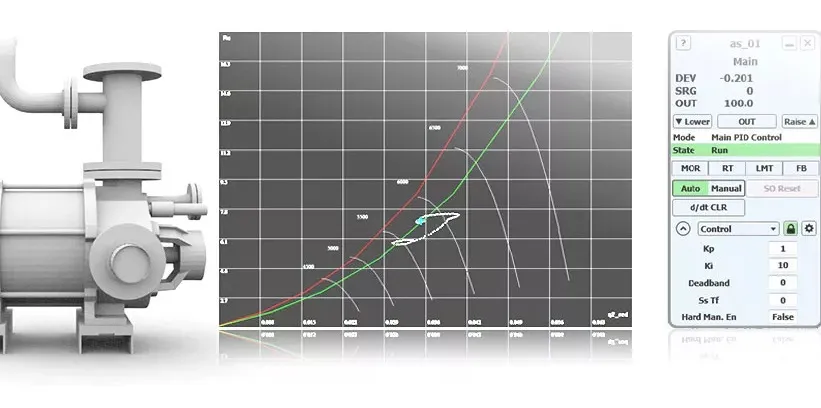
Fixed-interval washing schedules — common in legacy maintenance frameworks — are inherently inefficient. A field study at multiple North Sea offshore installations found that combining air intake filtration upgrades with condition-based online washing schedules reduced the rate of compressor performance deterioration compared to fixed-interval washing alone (A Field Study of Reduced Axial Compressor Performance Deterioration through Online Washing and Air Intake Filtration Upgrade). The practical implication: trending compressor inlet-to-delivery pressure ratio, corrected flow, and polytropic efficiency against the commissioning baseline gives you a quantitative trigger for washing rather than a calendar date.
The decision logic should be:
- Monitor corrected compressor efficiency and pressure ratio continuously against the established clean baseline.
- When a sustained downward trend in corrected efficiency is observed — not a transient excursion — initiate online washing.
- If online washing does not recover performance to within an acceptable band of the clean baseline, schedule an offline wash at the next available maintenance window.
- Track recovery magnitude after each wash. Diminishing recovery indicates deposit hardening; at that point, offline washing with detergent is required, and the interval to the next offline wash should be shortened.
| Parameter | Online Wash | Offline (Crank) Wash |
|---|---|---|
| Turbine state | Running at load | Shutdown, motored |
| Cleaning effectiveness | Partial — removes soft deposits | High — removes hard/baked deposits |
| Production impact | Minimal | Requires planned outage |
| Water volume required | Low | High |
| Detergent use | Optional / limited | Standard |
| Recommended trigger | Trending efficiency loss | Online wash no longer recovers performance |
Water Quality and Injection System Requirements
Demineralised water is mandatory. Dissolved salts introduced through wash water create a deposit chemistry worse than the original fouling, and can cause blade corrosion. The applicable OEM specifications for water purity must be followed.
Injection nozzle condition should be verified before each offline wash. Blocked or partially blocked nozzles cause uneven distribution and can introduce liquid slugs into the compressor at cranking speed.
Combustion Tuning
What Drifts and Why
Combustion tuning on a gas turbine defines the fuel-to-air ratio scheduling, pilot/main fuel split (on DLE/DLN burners), and ignition timing across the operating envelope. On offshore platforms burning associated gas, the Wobbe index of the fuel supply is not constant. As reservoir conditions change or gas processing varies, the energy content and combustion velocity of the fuel gas shifts. Leave the original control schedules in place and you get:
- Combustion dynamics (pressure oscillations) that exceed acceptable limits for liner and transition piece fatigue life
- Elevated NOₓ or CO emissions outside permitted limits
- Uneven temperature distribution at the turbine inlet, increasing first-stage nozzle and blade thermal gradient
The FPSO study (Cherednichenko et al., 2019) specifically identified that operating on associated gas conversion products required detailed analysis of combustion process parameters to maintain stable, efficient combustion — a task that cannot be delegated to a fixed OEM schedule.
Tuning Procedure Outline
Combustion tuning is an online procedure on most modern units but requires coordination with operations:
- Establish baseline: Record exhaust temperature spread (thermocouple-to-thermocouple variation), combustion dynamics sensor readings, exhaust emissions (NOₓ, CO, UHC), and exhaust gas temperature profile at current operating point.
- Fuel gas analysis: Obtain a current gas chromatograph analysis of the fuel supply. Compare Wobbe index to the value used for the last tuning event.
- Adjust fuel splits: On DLE/DLN systems, adjust pilot fuel percentage in small increments while monitoring dynamics, emissions, and exhaust temperature spread. Target the lowest pilot fraction that maintains stable combustion without dynamics exceedance.
- Verify across load range: Combustion behaviour changes with load. Tuning at base load only is insufficient; verify stability and emissions at part-load points relevant to the platform's actual operating profile.
- Document and lock: Record all adjusted parameters, the fuel gas composition at time of tuning, and the resulting performance data. This becomes the new baseline for the next tuning review.
Tuning frequency should be event-driven (significant fuel composition change, post-maintenance, after any combustion hardware replacement) rather than purely calendar-based.
Practical Scenario (Illustrative)
Picture a platform running two LM2500 gas turbines in a power-generation role, with a third on standby. Over several months, the operations team notices that Unit 1 needs progressively higher fuel valve position to hold rated output, and exhaust temperature spread has widened. Corrected compressor efficiency, trended against commissioning data, shows a sustained downward drift.
An online wash is performed using an optimised water-to-air ratio protocol. Corrected efficiency recovers partially but does not return to the clean baseline. At the next planned maintenance window, an offline crank wash with detergent solution is executed. Following the offline wash, corrected efficiency returns close to the clean baseline. At the same time, a recent gas chromatograph shows the Wobbe index has shifted from the last tuning event. A combustion tuning exercise is performed, adjusting pilot split to restore emissions compliance and reduce exhaust temperature spread. Together, the two actions bring the unit back to near-design heat rate.
This scenario is illustrative; specific performance recovery magnitudes are not stated as they depend on engine type, fouling severity, and operating history.
Maintenance Decision Checklist
Compressor Washing
- [ ] Is corrected compressor efficiency trended continuously against the commissioning baseline?
- [ ] Is wash water quality verified as demineralised and meeting OEM specification before each wash?
- [ ] Are online wash injection nozzles inspected and flow-tested at each offline wash interval?
- [ ] Is post-wash performance recovery magnitude recorded to detect diminishing returns?
- [ ] Is the offline wash interval shortened when online washing shows reduced recovery?
- [ ] Has the air intake filtration system been reviewed — filter grade, coalescer condition, and differential pressure trend — as a complement to the washing programme?
Combustion Tuning
- [ ] Is fuel gas composition (Wobbe index) tracked and compared to the value at last tuning?
- [ ] Are combustion dynamics sensor readings trended between tuning events?
- [ ] Is exhaust temperature spread monitored as an indicator of combustion uniformity?
- [ ] Are emissions (NOₓ, CO) within permitted limits across the operating load range?
- [ ] Is tuning triggered by fuel composition change, not only by calendar interval?
- [ ] Are tuning records — adjusted parameters, fuel composition, resulting performance — retained as the baseline for the next event?
Safety — Offline Washing Procedure Minimum Requirements Any offline crank wash requires: confirmed fuel gas isolation and zero-energy verification, lockout/tagout (LOTO) on all ignition and fuel systems, verification of zero fuel pressure upstream of the combustion system, hazardous-area classification review for water injection equipment, continuous gas detection active during the procedure, and controlled venting of any accumulated liquid from the compressor casing drain points before returning to service.
Conclusion
Compressor fouling and combustion drift are not background noise in offshore gas turbine operation — they are the primary mechanisms through which performance erodes between overhaul intervals. The evidence from North Sea LM2500 operations and FPSO combustion studies points to the same conclusion: fixed-interval maintenance schedules applied without reference to actual performance data leave recoverable efficiency on the table and accelerate hardware wear.
The next steps for any platform engineering team are straightforward. Establish clean-baseline performance records if they do not already exist. Implement continuous trending of corrected compressor efficiency and combustion temperature spread. Move wash scheduling to a condition-based trigger. Align combustion tuning to fuel composition changes, not the calendar. None of this is a capital project. It is disciplined use of data that most platforms already collect.