
Introduction: The Critical Importance of Compressor Stability
In the high-pressure, high-stakes environment of oil and gas processing, centrifugal compressors serve as vital components. They enhance pressure in essential operations such as gas injection, pipeline transportation, LNG production, refinery gas handling, and gas lift activities. However, these intricate machines function within stringent aerodynamic limits. Exceeding these boundaries, particularly entering the surge region, can lead to costly damage, catastrophic failures, and significant production downtime. Effective surge control is not merely an engineering preference; it is a fundamental necessity for asset integrity, operational safety, and economic viability. This article provides an in-depth examination of the surge phenomenon, evaluates traditional and innovative control strategies, and presents best practices for integrated anti-surge system design.
Understanding the Surge Phenomenon: An Aerodynamic Instability
Surge is a dynamic instability that occurs in dynamic compressors (both centrifugal and axial) when the flow through the machine becomes inadequate for the pressure it aims to generate. This phenomenon is characterized by a complete breakdown of stable flow, resulting in violent oscillations.
-
The Aerodynamic Mechanism:
- Operating Point: A compressor operates stably where its performance curve (Head vs. Flow) intersects with the system resistance curve (backpressure).
- Reduced Flow: If system resistance increases (e.g., a valve closes downstream) or speed decreases, the operating point shifts left on the curve.
- Stall Inception: As flow diminishes, flow separation begins within the impeller or diffuser passages (stall).
- Flow Reversal: At the surge point (the extreme left of the curve), the pressure generated by the compressor temporarily exceeds the system pressure. This pressure differential becomes insurmountable for the reduced flow, causing an instantaneous reversal of flow back through the compressor.
- Pressure Collapse & Recovery: The reversed flow swiftly discharges the system pressure downstream. Once pressure equalizes, forward flow resumes, pressure builds again, and the cycle repeats if operating conditions remain unchanged.
-
Characteristics of Surge:
- Violent Oscillations: Rapid, large-amplitude oscillations in flow (often reversing), discharge pressure, and drive power.
- Acoustic Signature: Loud, distinctive low-frequency pulsing or “whooping” sounds.
- Mechanical Vibration: Severe vibrations transmitted throughout the compressor, piping, and foundation due to rapid flow reversals and aerodynamic forces.
Dire Consequences: Why Surge Must Be Prevented at All Costs
The destructive potential of surge is significant. Consequences include:
-
Severe Mechanical Damage:
- Thrust Bearings: Rapid flow reversals impose extreme alternating loads on thrust bearings, leading to rapid wear or catastrophic failure.
- Radial Bearings: High vibration levels can damage radial bearings.
- Seals: Dry gas seals (DGS) and labyrinth seals may suffer catastrophic damage due to contact during violent vibrations and flow reversals, leading to gas leaks and potential safety hazards.
- Impellers & Diffusers: High cyclic stresses can induce fatigue cracking in impellers, blades, and diffuser vanes. Blade resonance during surge can lead to breakage.
- Couplings & Shafts: Torsional vibrations and high thrust loads can damage couplings and potentially bend the rotor shaft.
- Piping & Supports: High-pressure pulsations and mechanical vibrations stress piping, welds, and support structures, risking leaks or rupture.
-
Operational & Economic Impact:
- Production Downtime: Compressor trips or failures necessitate shutdowns, halting production processes. Restarting complex processes is both time-consuming and costly.
- High Repair Costs: Replacing damaged bearings, seals, impellers, or rotors is expensive. Downtime costs often far exceed repair parts.
- Reduced Efficiency & Capacity: Operating near the surge limit (with margin) or recovering from surge events diminishes overall plant efficiency and throughput.
- Safety Risks: Seal failure can release flammable or toxic gases. Mechanical disintegration poses severe hazards to personnel, with fire or explosion being a real possibility.
Traditional Anti-Surge Control Methods: The Foundation
The core principle of anti-surge control is straightforward: Prevent the operating point from crossing the surge limit line (SLL). This is accomplished by rapidly opening a recycle valve (anti-surge valve – ASV) to increase flow through the compressor when the operating point approaches the SLL.
-
The Anti-Surge Valve (ASV) & Bypass Line:
- A specially designed, fast-acting valve installed in a bypass line connecting the compressor discharge back to the suction (or an intermediate point). Opening this valve reduces system resistance, thereby increasing compressor flow.
-
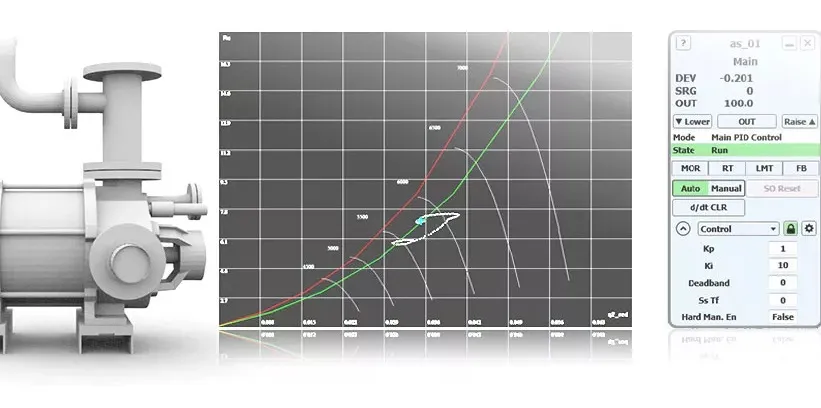
Traditionally, the SLL is a line plotted on a compressor map (Head vs. Flow or Pressure Ratio vs. Flow). It represents the locus of surge points determined during shop testing at various speeds, but it can shift with gas composition, inlet conditions, fouling, and speed variations.:
- Traditionally, the SLL is a fixed line plotted on a compressor map (Head vs. Flow or Pressure Ratio vs. Flow). It represents the locus of surge points determined during shop testing at various speeds. A safety margin (Surge Control Line – SCL) is set parallel to the SLL.
-
Surge parameter calculations should reflect the complexity of the system and include considerations for real-time adjustments based on operational conditions, rather than relying solely on simplified ratios.:
- Measurement: Key parameters are measured: Suction Pressure (P1), Discharge Pressure (P2), Suction Temperature (T1), and Flow (F). Differential Pressure (dP) across a flow element is often used.
- Surge Parameter Calculation: A “surge parameter” proportional to the operating point’s proximity to the SCL is calculated. Common parameters include:
(H / H_surge) - 1(Head Ratio)(dP / P1) / (dP / P1)_surge(Normalized Flow Ratio)(F / F_surge)(Simplified Flow Ratio)
- Control Algorithm: A Proportional-Integral-Derivative (PID) controller acts on the “surge margin” (distance from SCL). If the margin falls below zero (operating point crosses SCL), the controller output rapidly increases.
- Valve Action: The controller output drives the ASV towards opening. The speed of opening is critical to quickly arrest surge onset.
- Recovery: Once the operating point moves safely away from the SCL (surge margin positive), the controller gradually closes the ASV to minimize energy waste while maintaining stability.
While traditional PID controllers can exhibit sluggishness or oscillatory behavior if not properly tuned for specific operating points, their effectiveness can be maintained through careful tuning and consideration of the specific compressor characteristics.
While effective for many applications, traditional PID controllers exhibit significant limitations:
- Fixed SCL: Assumes the SLL is constant. In reality, the SLL shifts with gas composition, inlet conditions (P1, T1), fouling, and speed variations. A fixed SCL with a large safety margin wastes energy; one too close risks surge if the SLL shifts unexpectedly.
- Fixed Controller Gains (P, I, D): Tuned for one operating point, often becoming sluggish (slow to open) or aggressive (oscillatory) at other points, compromising both protection and efficiency.
- Limited Predictive Capability: Reacts after the operating point nears the SCL, rather than predicting and preventing the approach. Response time limitations can still allow incipient surge.
- Handling Complex Configurations: Challenging for compressors with side streams, multiple sections, or variable geometry.
Modern Advanced Anti-Surge Algorithms: Intelligence and Adaptability
To address the limitations of fixed PID controllers, sophisticated algorithms have emerged:
-
Adaptive Gain Scheduling:
- Concept: Dynamically adjusts the PID controller gains (P, I, D) based on the current operating point (e.g., speed, flow, head).
- Benefit: Maintains optimal controller responsiveness (fast, stable, non-oscillatory) across the entire operating range. Provides aggressive opening near surge and smooth closing away from surge, improving stability and efficiency.
- Implementation: Utilizes pre-configured gain maps or real-time calculations based on operating parameters.
-
Adaptive Surge Control Line (ASCL):
- Concept: Dynamically adjusts the Surge Control Line (SCL) position based on real-time measurements and operating conditions. Moves the SCL closer to the actual surge limit when conditions allow (reducing recycle), and further away when conditions worsen (increasing protection).
- Methods:
- Model-Based: Uses a real-time aerodynamic model of the compressor (simplified) to estimate the current surge margin and adjust the SCL.
- Performance-Based: Monitors parameters like efficiency, vibration trends, or acoustic signatures that correlate with proximity to surge. Subtly adjusts the SCL if precursors are detected.
- Statistical Learning: Analyzes historical operating data near surge events to learn how the SLL shifts under different conditions.
- Benefit: Maximizes operational efficiency by minimizing unnecessary recycle flow while maintaining robust protection against the actual surge limit, not a fixed approximation.
-
While MPC does require a good system model and robust hardware, advancements in computational capabilities and software have made it increasingly practical for real-time applications in complex systems.:
- Concept: Utilizes a dynamic model of the entire compressor system (compressor, piping, valves, process) to predict future operating points over a finite horizon (seconds ahead). Optimizes ASV movements to prevent the predicted operating point from violating constraints (such as crossing the SCL), while also considering other process objectives (e.g., minimizing recycle, maintaining discharge pressure).
- Benefit: Truly predictive and proactive. Handles complex interactions and multiple constraints elegantly. Can optimize overall process performance, not just surge avoidance. Excellent for multivariable control (e.g., coordinating ASV with speed or guide vanes).
- Implementation: Computationally intensive, requiring a good system model and robust hardware.
-
Nonlinear Control Techniques (e.g., Lyapunov-based, Feedback Linearization):
- Concept: Treats the compressor dynamics explicitly as nonlinear. Designs control laws based on nonlinear stability theory to guarantee stability within a defined region around the operating point, inherently rejecting disturbances pushing it towards surge.
- Benefit: Theoretically rigorous stability guarantees. Can effectively handle large disturbances.
- Implementation: Often mathematically complex, requiring accurate nonlinear models. Gaining traction in research and advanced industrial applications.
Integrated Anti-Surge System Design: Best Practices
Implementing effective surge control necessitates a holistic system approach, not just an algorithm:
-
Robust Instrumentation & Redundancy:
- Critical Measurements (P1, P2, T1, Flow): Employ high-accuracy, fast-response transmitters. Redundancy (2oo3 voting logic is common for flow and pressure) is essential for safety and availability. A single instrument failure must not cause a false trip or impede surge detection.
- Vibration Monitoring: Integrate with machinery protection systems (e.g., Bently Nevada) for surge detection and correlation.
- Acoustic Monitoring: Surge-specific microphones can provide early warning.
- Valve Position Feedback: Critical for the controller to accurately know ASV position.
-
High-Performance Anti-Surge Valve (ASV):
- Fast Stroke Time: Must open from closed to fully open in < 1-2 seconds (often < 300ms for critical services). Requires high-capacity positioners and robust actuators (usually pneumatic).
- Inherent Characteristics: Equal percentage trim is generally preferred for good controllability over a wide range of operation.
- Sizing: Correct sizing is crucial. Undersized valves cannot pass enough flow to prevent surge. Oversized valves can be difficult to control stably at small openings. Consider “Dual Valves” (large/small) for very wide operating ranges.
- Fail-Safe Action: Must fail open (FO) on loss of signal or power to ensure protection.
- Materials & Design: Suitability for the process gas, pressures, temperatures, and potential for erosion or corrosion.
-
Dedicated, Certified Controller Hardware:
- PLC vs. DCS vs. Dedicated System: While PLCs/DCS can execute basic PID, advanced algorithms (especially MPC) often require dedicated, high-performance hardware (e.g., specialized compressor control systems – CCC from vendors like Compressor Controls Corporation, Siemens, Woodward, GE). These offer:
- Ultra-fast scan times (< 50ms).
- Certified safety integrity levels (SIL 2/3).
- Robust communication protocols (Modbus TCP, OPC UA).
- Redundant processors, power supplies, and I/O cards.
- Safety Integrity Level (SIL): Determine the required SIL based on risk assessment (e.g., IEC 61511). Implement accordingly (redundant hardware, diagnostics, certified logic solvers).
- PLC vs. DCS vs. Dedicated System: While PLCs/DCS can execute basic PID, advanced algorithms (especially MPC) often require dedicated, high-performance hardware (e.g., specialized compressor control systems – CCC from vendors like Compressor Controls Corporation, Siemens, Woodward, GE). These offer:
-
Thorough Commissioning & Testing:
- Loop Checks: Verify every instrument, cable, and valve action meticulously.
- Controller Tuning: Perform open-loop and closed-loop tuning across the operating range. Use step tests and bump tests. For adaptive controllers, verify gain schedules or model performance.
- Surge Testing (If Possible & Safe): Under controlled conditions during commissioning, carefully approach the surge limit to verify the SLL and controller response. This is high-risk and requires extreme caution and preparation.
- Functional Safety Testing (SIL): Verify all safety instrumented functions (SIFs) related to surge protection meet the required SIL.
-
Operator Interface & Alarms:
- Clear Visualization: Real-time display of the compressor map showing operating point, SCL, SLL, surge margin, and ASV position.
- Early Warning Alarms: Alarms for “Surge Margin Low” and “Surge Control Active” well before any danger.
- Diagnostic Alarms: Alarms for instrument faults, valve issues, and controller health.
- Historical Trends: Essential for troubleshooting events and optimizing performance.
-
Integration with Process Control & Optimization:
- Coordinate with Capacity Control: Anti-surge control (recycle) and capacity control (speed, inlet guide vanes, discharge throttling) must work together seamlessly to avoid conflicts. Often managed by an integrated compressor controller.
- Optimization Layer: Advanced systems can minimize recycle flow while maintaining surge margin and meeting process demands, optimizing energy consumption. MPC excels in this area.
The Future: Digitalization and Advanced Analytics
The future of surge control lies in leveraging data and digital technologies:
-
Digital Twins: High-fidelity dynamic models of the compressor system running in parallel with the physical asset. Used for real-time performance monitoring, predictive surge margin calculation, controller optimization, and “what-if” scenario testing.
-
Machine Learning (ML) & AI:
- SLL Prediction: ML models trained on operational data can predict SLL shifts due to fouling or gas composition changes more accurately than traditional methods.
- Anomaly Detection: Detect subtle precursors to surge or valve stiction using vibration, acoustic, or process data patterns.
- Predictive Maintenance: Analyze surge events (frequency, severity) and valve cycling to predict maintenance needs for bearings, seals, and the ASV itself.
-
Cloud-Based Analytics: Centralized platforms aggregating data from multiple compressors fleet-wide for benchmarking, best practice sharing, and identifying optimization opportunities.
Conclusion: Protecting Critical Assets with Intelligence
Centrifugal compressor surge is a destructive force that necessitates a sophisticated, multi-layered defense. While traditional PID controllers and fixed surge lines provide a fundamental level of protection, modern adaptive algorithms such as gain scheduling, adaptive surge control lines, and Model Predictive Control offer substantial advantages in efficiency, stability, and robustness, particularly amid the changing operating conditions prevalent in the oil and gas industry.
However, the effectiveness of an algorithm is contingent upon the system it governs. Success relies on integrated design: redundant, high-fidelity instrumentation; a fast, reliable, and appropriately sized anti-surge valve; dedicated, high-performance controller hardware; meticulous commissioning; and clear operator interfaces. By adopting best practices in system design and utilizing advanced control strategies, operators can ensure their critical centrifugal compressors operate safely, reliably, and efficiently, far from the destructive edge of surge, maximizing asset life and minimizing costly downtime. The integration of digital twins and AI promises even greater levels of protection, prediction, and optimization in the years to come, establishing surge control as a cornerstone of intelligent asset management in the oil and gas sector.
Table 1: Comparison of Anti-Surge Control Methods
| Feature | Traditional PID | Adaptive Gain Scheduling | Adaptive Surge Line (ASCL) | Model Predictive Control (MPC) |
|---|---|---|---|---|
| Surge Line (SCL) | Fixed | Fixed | Dynamic | Dynamic (Model-Based) |
| Controller Gains | Fixed | Dynamic | Fixed or Dynamic | Implicitly Optimized |
| Response Type | Reactive | Reactive (Improved) | Reactive (Improved) | Proactive / Predictive |
| Efficiency | Lower (Large Margin) | Medium | High | High (Optimized) |
| Protection Robustness | Medium (Fixed SCL) | Medium (Fixed SCL) | High (Adapts SCL) | High |
| Handles SLL Shifts | Poor | Poor | Good | Good |
| Complexity | Low | Medium | Medium | High |
| Implementation Cost | Low | Medium | Medium | High |
| Best For | Simple, Stable Processes | Wide Operating Range | Changing Gas/Conditions | Complex Systems, Multivariable |
FAQ Section:
-
Q: How close can I safely operate to the surge limit?
A: The required surge margin (distance between SCL and SLL) depends on control system performance, instrumentation accuracy, and process stability. With basic PID, a 10-15% margin is common. NEVER operate without a safety margin. -
Q: Can surge occur even with an anti-surge controller?
A: Yes, if the system response is too slow (slow valve, slow controller), instrumentation fails (without adequate redundancy), the controller is poorly tuned, or the SLL shifts drastically and unexpectedly beyond the system’s ability to adapt. Robust design minimizes this risk. -
Q: What’s the difference between surge control and surge prevention?
A: Surge control implies the system reacts once surge is imminent or incipient to arrest it. Surge prevention aims to keep the operating point always safely away from the surge limit. Advanced algorithms with predictive capabilities blur this line, aiming for prevention. -
Q: How often should anti-surge systems be tested?
A: Regular functional testing is crucial. This includes verifying instrument readings, valve stroking times, and controller logic response during planned shutdowns or online (if safe procedures exist). The frequency depends on criticality and SIL requirements (e.g., quarterly or annually). Partial stroke tests for the ASV might be done more frequently. -
Q: Is MPC worth the cost?
A: For large, critical compressors with variable operating conditions (common in oil & gas), where energy savings from reduced recycle are significant, or complex multivariable control is needed, MPC often provides a compelling ROI through increased efficiency, throughput, and reliability.